
Meta-Analysis Services for Health and Social Science Research
Meta-Analysis Services for Health and Social Science Research
A well-run meta-analysis can answer questions that no single study can. It pools results from many studies, gives a more precise estimate of an effect and shows where findings agree or conflict. It is also technical, slow and easy to get wrong. Research Bureau provides meta-analysis services for postgraduate students, clinicians, academics and organisations who need reliable evidence synthesis.

What Our Meta-Analysis Services Include
- Protocol development. PICO or PECO questions, eligibility criteria and analysis plans, ready for PROSPERO registration where relevant.
- Search strategy. Database searches in PubMed, Scopus, Web of Science, CINAHL, PsycINFO and African databases, with full search strings documented.
- Screening. Title, abstract and full-text screening with clear reasons for exclusion and a PRISMA flow diagram.
- Data extraction. Structured extraction forms for study characteristics, outcomes and effect data.
- Risk of bias. Cochrane RoB 2, ROBINS-I, Newcastle-Ottawa or JBI tools, depending on study design.
- Statistical synthesis. Effect sizes, fixed and random effects models, heterogeneity (I² and tau²), subgroup analysis and meta-regression.
- Publication bias. Funnel plots, Egger’s test and trim-and-fill where appropriate.
- Reporting. Forest plots, summary tables and a write-up that follows PRISMA 2020.
Software We Use
Our meta-analysis services use R (metafor, meta), Stata, RevMan and Comprehensive Meta-Analysis. We share the analysis files with you, so the work is transparent and can be checked by supervisors, reviewers or co-authors.
Who Uses Our Meta-Analysis Services
Most of our clients are in health sciences: medicine, nursing, pharmacy, public health and physiotherapy. We also work in education, psychology, management and development economics, where meta-analysis is growing fast. MMed and PhD candidates often use us for a meta-analysis chapter or a publishable review.
Systematic Review Versus Meta-Analysis
A systematic review collects and appraises all relevant studies on a question. A meta-analysis is the statistical step that combines their results. Not every review can or should include one. If studies are too different, a narrative synthesis may be more honest. Part of our meta-analysis services is telling you early whether pooling makes sense for your question.
How the Process Works
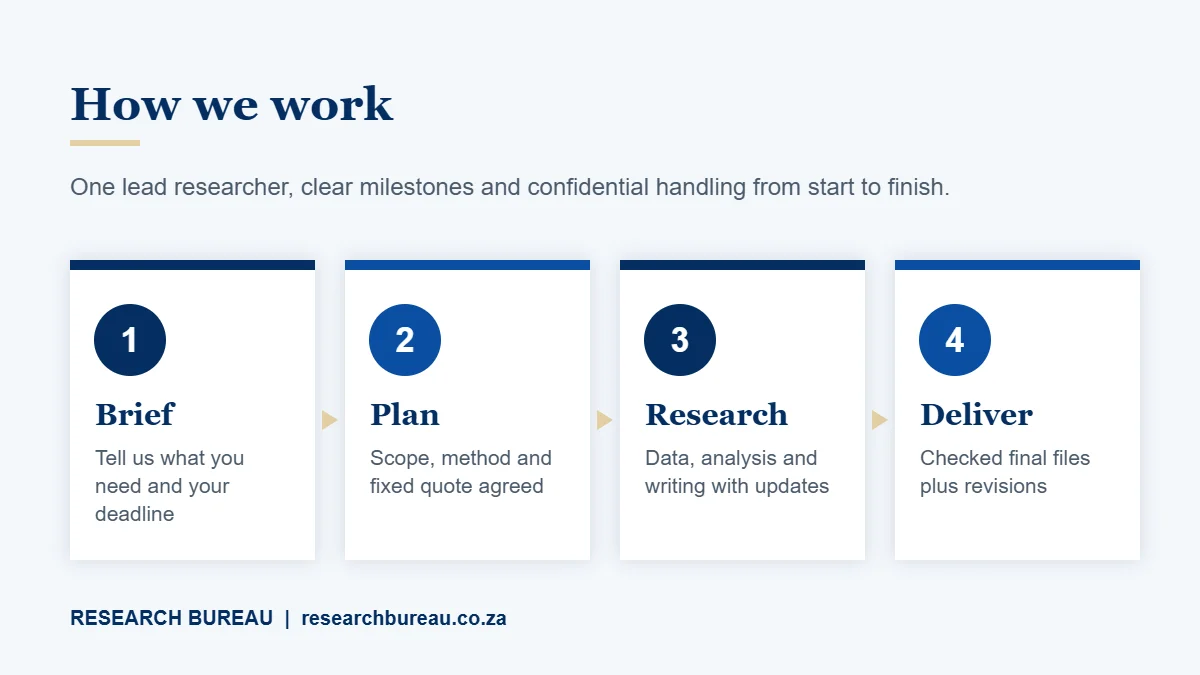
1. Consultation. Send your research question and any protocol you have. We assess feasibility.
2. Plan and quote. We agree on the stages you need help with, from search to full write-up.
3. Execution. We run the agreed steps, with check-ins at screening and extraction.
4. Results and reporting. You receive the analysis, figures, tables and a methods and results write-up.
Quality and Transparency
Good meta-analysis services must be reproducible. Every decision is logged, from search dates to exclusion reasons and model choices. Dual screening and dual extraction are available for higher-stakes projects. That audit trail protects you when examiners or journal reviewers ask how a result was produced.
Frequently Asked Questions About Meta-Analysis Services
How many studies do I need for a meta-analysis?
Technically two, but results become more meaningful with more studies. We advise based on your field and question.
Can you help with network meta-analysis?
Yes, for suitable questions. Ask us for a feasibility check.
Can you redo the analysis after reviewer comments?
Yes. We update models, add sensitivity analyses and help you respond to reviewers.
How long does it take?
A full review with meta-analysis usually takes several weeks, mainly because of searching and screening. Analysis-only projects with extracted data are much quicker.
Request Meta-Analysis Services
Email your research question, field and deadline to info@researchbureau.co.za. We will reply with a feasibility view and a quote for meta-analysis services matched to your project.

Related Services
These Research Bureau services often go hand in hand with Meta-Analysis services:
Want some background reading first? The Wikipedia article on Meta-analysis gives a neutral overview of the wider topic.